
How Intelligent Consolidation Transforms Aviation Logistics Economics
By Tulika Dayal, COO & Co-founder at SkySelect.
In aviation maintenance, costs rarely escalate due to a single major decision. More often, it grows quietly through repetition. A part was ordered here. A shipment was expedited there. A purchase order is created to solve a time-sensitive requirement. Each action makes sense in isolation. The aircraft must return to service. The check must remain on schedule. The operation must move forward.
Airlines operating billions in annual TechOps spend are already applying AI intelligence to thousands of monthly transactions, proving that consolidation is executable at scale. It is dynamic consolidation driven by demand signals, supplier risk exposure, repair turn times, and logistics modeling. In the next decade of aviation supply chain management, the competitive divide will not be determined by who buys the best parts — but by who coordinates the network most intelligently.
Yet across TechOps organizations, these small, reactive decisions create a structural inefficiency that is largely invisible until examined holistically. Multiple small purchase orders trigger multiple freight charges. Separate shipments from the same supplier move through customs independently. Administrative processing repeats. Accounts payable handles a growing volume of invoices. Suppliers never gain the demand visibility needed to offer stronger pricing or terms. The parts themselves may be identical, but the pathway to acquiring them dramatically changes the total cost. Executives often negotiate favorable shipping arrangements with key suppliers that reduce total costs, but these arrangements can ultimately be suboptimal.
The difference between five small orders and one consolidated order is not administrative; it is economic.
Traditional ERP and MRP systems are essential for recording transactions and maintaining compliance, but they are not built to continuously optimize across them. They execute what is requested. They do not pause to evaluate whether five separate purchases should be treated as a single coordinated movement. They do not analyze supplier geography, open maintenance requirements, inventory positions across stations, or freight patterns in real time to determine whether consolidation could reduce cost and complexity.
This is where SkySelect introduces a fundamentally different approach.
SkySelect functions as an intelligence layer that sits alongside existing systems and continuously analyzes procurement and supply chain activity as a connected network rather than as isolated transactions. Instead of viewing a part requirement as a standalone event, the platform evaluates open purchase orders, forecasted maintenance demand, supplier performance, inventory distribution, lead times, pricing patterns, and logistics routes simultaneously.
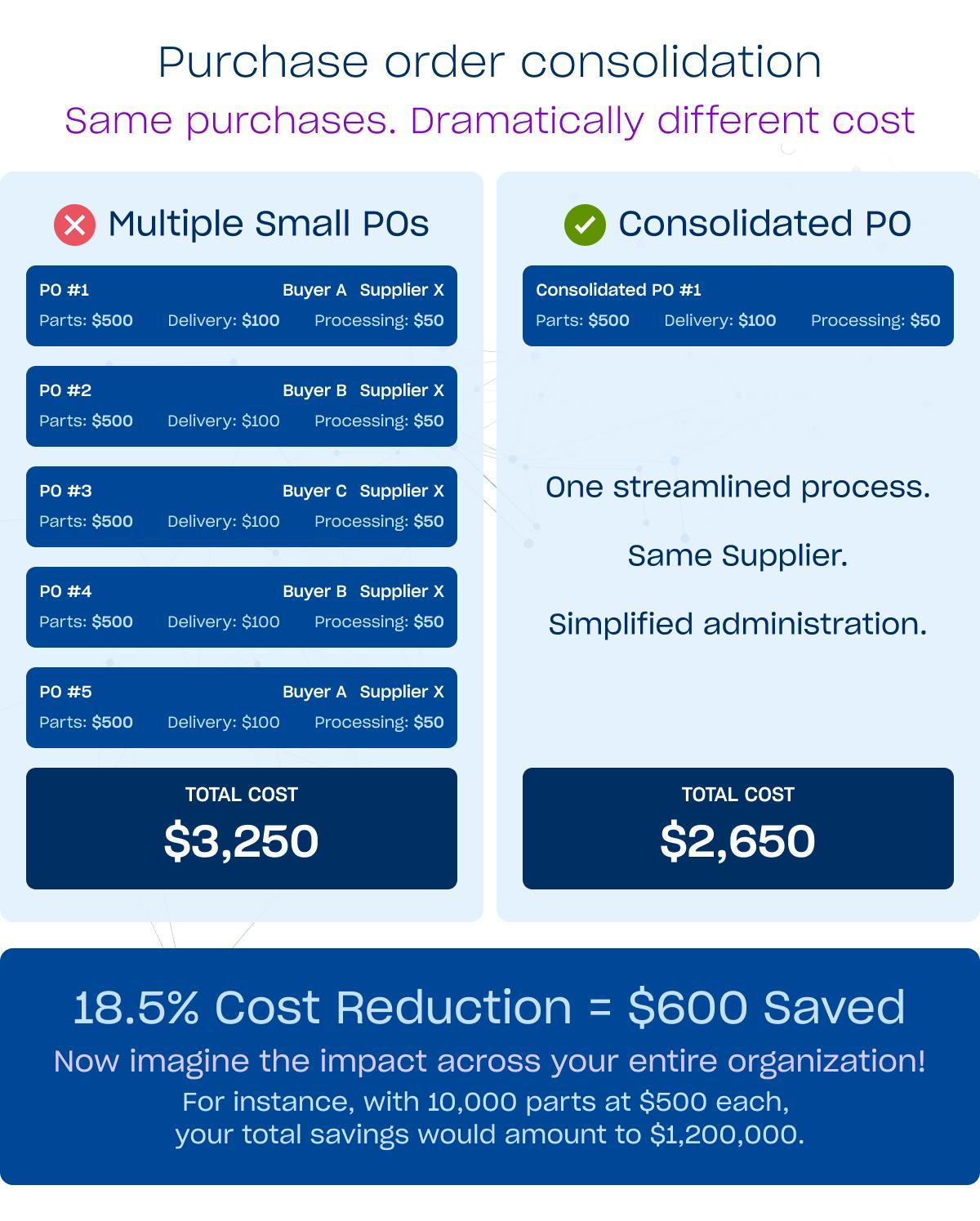
By connecting these variables, SkySelect identifies opportunities for intelligent consolidation that would otherwise remain invisible. Across buyers and teams, separate orders from the same supplier can be bundled into a single shipment. Planned heavy maintenance demand can be aligned with coordinated purchasing windows. Inventory at one station can offset a new purchase at another. Repair options can be weighed against exchange or outright procurement to minimize unnecessary freight events. What appears urgent in isolation often becomes manageable when viewed across the broader supply chain landscape.
The impact is both immediate and compounding.
Freight costs decline as redundant shipments are reduced. Bulk purchasing unlocks stronger pricing and improved commercial terms. Administrative workload decreases as invoice volume and processing events consolidate. Customs exposure and brokerage fees decline. Warehouse receiving and inspection events become more predictable. Supplier relationships strengthen as volume visibility improves. The network begins to operate with coordination rather than fragmentation.
Over time, this shifts TechOps from reactive buying to orchestrated execution.
The financial implications are significant. In simplified purchasing scenarios, consolidating orders can reduce total costs by more than 20% when shipping, processing, and volume discounts are accounted for. In aviation, where part values and freight premiums are materially higher than in general procurement categories, the impact scales quickly. Across thousands of purchase orders annually, intelligent consolidation can save millions of dollars in logistics and transaction costs.
But the strategic value extends beyond savings.
In an environment where heavy check volumes are increasing and supply chain volatility remains elevated, resilience becomes just as important as efficiency. Coordinated purchasing reduces the number of moving pieces within the network. Fewer shipments mean fewer potential delays. Earlier planning reduces last-minute expediting. Greater visibility into supplier performance strengthens decision-making under pressure. When consolidation is driven by real-time intelligence rather than manual coordination, recovery performance improves alongside cost control.
This is particularly relevant as airlines prepare for elevated maintenance cycles and complex fleet demands in the coming years. Anticipating material requirements across scheduled C-checks and aligning procurement accordingly reduces the likelihood of mid-event disruptions. Instead of responding to shortages after they surface, procurement teams can proactively structure purchasing strategies around forecasted demand, risk signals, and supplier capacity. The result is fewer emergency freight premiums and more predictable aircraft return-to-service timelines.
SkySelect also extends this intelligence into the repair strategy. Decisions between repair, exchange, and new procurement significantly influence logistics flow and working capital deployment. By evaluating turnaround times, cost curves, and supply risk, the platform helps determine not only the lowest unit price but also the most economically efficient pathway across the part's lifecycle. This integration of procurement and repair intelligence further enhances consolidation opportunities and strengthens overall supply chain performance.
What makes this approach powerful is that it does not require replacing core systems or restructuring operations. It enhances what already exists. ERP and MRP remain the backbone of execution, while SkySelect continuously optimizes the decisions flowing through them. The organization retains control and visibility, but gains an intelligence capability that was previously unavailable.
In aviation, margins are disciplined, and operational reliability is non-negotiable. Small inefficiencies, repeated at scale, create meaningful financial impact. Conversely, small optimizations, applied consistently across thousands of transactions, compound into a measurable advantage.
The parts do not change. The suppliers do not change. The maintenance work remains as demanding as ever. What changes is the coordination.
When procurement decisions are connected across the network rather than executed in isolation, logistics costs decline, administrative burden lightens, supplier leverage improves, and recovery performance strengthens. The difference between fragmented purchasing and intelligent consolidation becomes evident not just in spreadsheets but also in the operational rhythm.
Same parts. Dramatically different cost. And at scale, that difference defines competitive advantage.

With Procurement AI, you gain real-time visibility into your supply chain, providing a complete understanding of parts availability. This award-winning platform enables you to plan confidently by proactively adjusting stock levels based on market dynamics and unlocking significant working capital, all while effectively avoiding costly delays.